The Six Principles of Pilates
AS SEEN IN




HISTORICAL CONTEXT
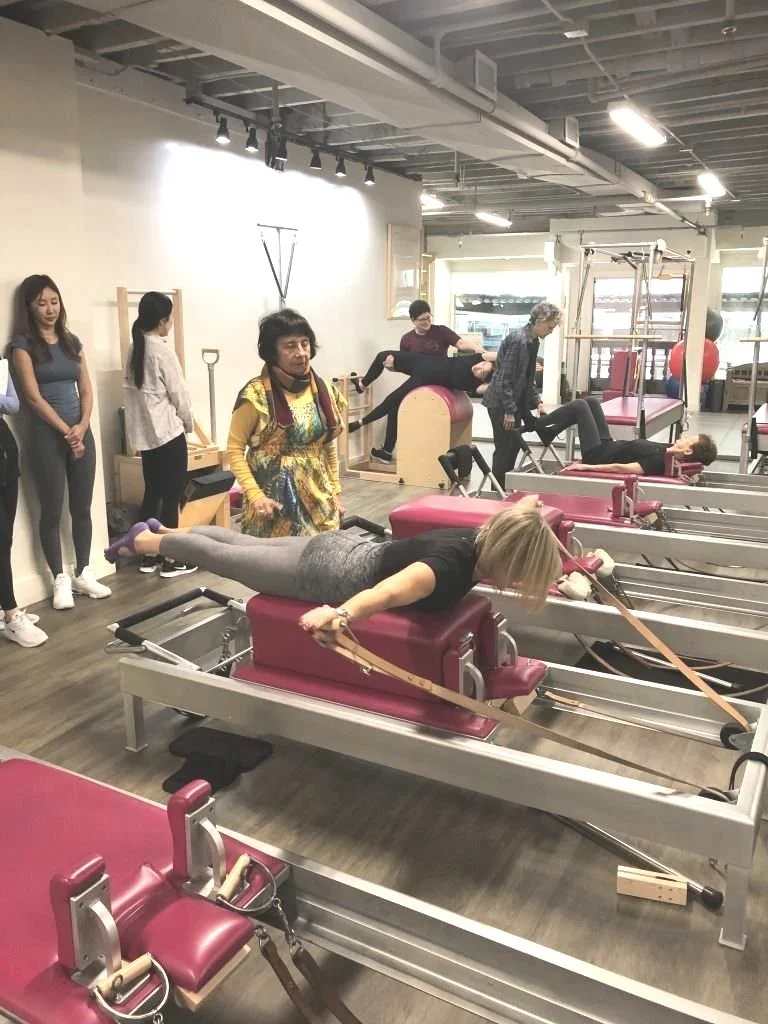
Joseph Pilates never formally published a numbered list of principles. The Six Principles Concentration, Centering, Control, Breathing, Precision, and Flow were formally codified in The Pilates Method of Physical and Mental Conditioning (1980) by Philip Friedman and Gail Eisen, two students of Romana Kryzanowska. Published more than a decade after Joe’s death, it was the first modern book on the method. Friedman and Eisen distilled Joe’s teachings into six organising principles to make the work accessible to a wider audience. The principles are entirely grounded in Joe’s own writings and teaching philosophy but the act of naming and numbering them belongs to this generation within his lineage.
This is worth understanding because it illustrates how the lineage has always worked: not one person holding all knowledge in isolation, but a chain of devoted students making the work more transmissible while remaining anchored to what they received.
WHY THEY MATTER
The Six Principles are not rules to follow sequentially. They are qualities to cultivate simultaneously — present in every exercise, on every apparatus, in every session. Think of them as the strings of a chord. The moment one is dropped, the sound changes.
-
Concentration
The mind must be present and actively directing the movement. Mindless repetition does not produce change. Only conscious, directed movement rewires the neuromuscular system.
-
Centering
All movement initiates from the powerhouse — the deep core from the base of the ribs to the top of the pelvis. When the centre is stable, the extremities move with freedom and precision. This is not metaphor. It is anatomy.
-
Control
Contrology translates as the study of control. No movement is performed with momentum, gravity, or habit. Every inch of every exercise is governed by muscular control. This is what distinguishes the method from exercise — it demands mastery, not just effort.
-
Breathing
Joseph Pilates described breathing as the internal shower of the body and believed that forced, full exhalation was the foundation of good health. Each exercise carries a specific breathing pattern to maximise oxygenation and engage the deep abdominal musculature.
-
Precision
There are no approximate exercises in this method. Every position, every transition, every point of the body in space has a specific and intentional placement. Precision is the difference between stimulating the correct tissue and reinforcing a compensation.
-
Flow
The exercises move from one to the next with economy and rhythm. Flow is not speed. It is the quality that comes from genuine mastery — when effort disappears and the body moves as a unified whole.
For a deeper exploration of each principle and its historical context, visit: lifespanpilates.com/roots/the-six-principles
Connect